
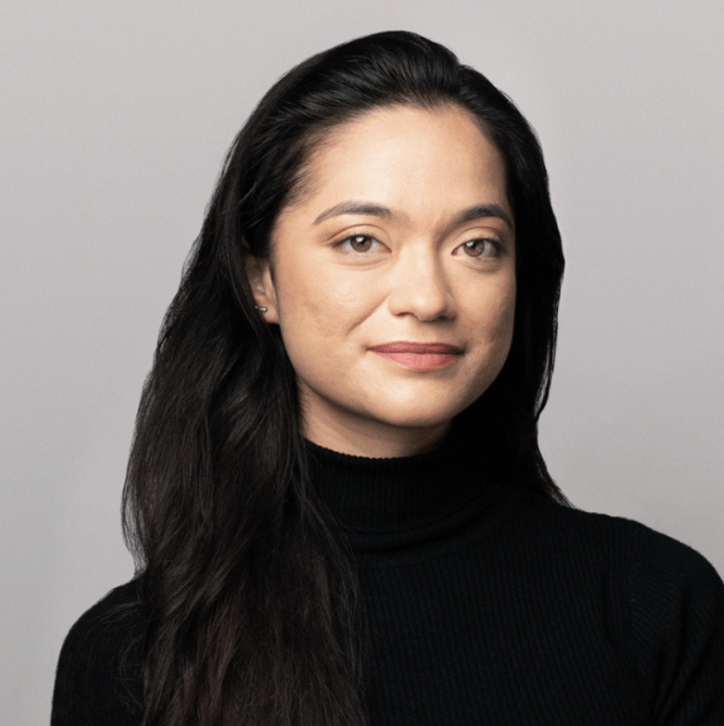
 Kelly Kimball
Managing Editor, More to Her Story | USA
Short Bio: Kelly Kimball is the Managing Editor of More to Her Story, a global newsroom amplifying women’s and girls’ voices through rigorous reporting, features and investigations. An award-winning reporter, editor and social media strategist based in New York City, Kelly also serves as an adjunct professor at the Craig Newmark Graduate School of Journalism at CUNY, where she teaches law, ethics and safety. Her reporting and editorial work has appeared in Foreign Policy, the San Francisco Chronicle, the Poynter Institute, Heat Map News, Long Lead, and more, reflecting her commitment to helping readers navigate the complexities of international affairs, war and conflict, the geopolitics of climate change, and the ripple effects of global flashpoints.
Event: SDGs Conference 2025
Date: September 24, 2025
SPEECH: Our mission is urgent yet simple: to center the voices of women and girls through robustly reported journalism. Nearly every story we publish crosses my desk, and with each one, I am reminded of the weight of our responsibility, because many of these stories rarely make it into the headlines of mainstream media.
Our newsroom has grown rapidly in recent years, with over 120 reporters filing stories from underreported geographies, refugee camps, war zones, border crossings, rural villages, and protected wildlands. We have published investigations into everything from sexual abuse in Malawi’s tea plantations, period poverty in Gaza, to forced hysterectomies in India’s sugarcane belt, to Afghan girls defying Taliban restrictions by enrolling in underground schools or taking classes over clandestine radio programming.
These are not side stories. They are the story. They tell us about the ripple effects of global flashpoints and about how the status of women is inextricably tied to the state of our societies. As world leaders gather in New York, I want to share from my vantage point as a global affairs journalist what I believe is one of the greatest impediments to peace and prosperity today: the stagnating, and in many cases worsening, status of women worldwide.
Across the regions we cover, a sobering pattern emerges. In Afghanistan, four years after the Taliban’s return to power, women face what the International Criminal Court now calls gender persecution; women on the ground are calling it something far more severe: Gender Apartheid. From the banning of girls’ education beyond primary school to the imprisonment of women for defying dress codes, Afghan women live under a system of near-total erasure. Yet Afghan women continue to resist, it’s why our newsroom continues to keep their voices and experiences alive by partnering with Afghan women-led newsrooms Rukhshana Media and Zan Times, to remind the world that women are never passive victims of history, but agents of defiance and resilience.
In Iran, women remain on the frontlines of one of the most defiant civil rights movements in recent memory. The crackdown that followed the death of Mahsa Amini in 2022, which passed its third anniversary this month, has only intensified, but global headlines have precipitously fallen from the top fold. Women are surveilled, fined, beaten, electric shocked, and imprisoned for showing their hair or peacefully protesting, yet millions continue to engage in creative acts of daily resistance. Their struggle shows us that gender equality is not a cultural afterthought; it is a litmus test of a society’s democratic health.
In Gaza, our reporters have told the stories of women enduring the impossible: war, displacement, and deprivation layered upon entrenched gender inequality. We’ve covered the quiet yet pervasive crisis of menstrual dignity and maternal mortality, issues that rarely surface in international negotiations but that define survival for half the population. These stories are not distractions from geopolitics; they are its sharpest consequence.
In Sudan, where the war has fractured governance and left civilians unprotected, women are sustaining both survival and the vision for peace. Dr. Entisar Abdelsadig, a leading women, peace, and security expert, has repeatedly demonstrated that Sudanese women can and must be central to negotiations, as leaders shaping ceasefires and political transitions. Her experience in Geneva in August 2024, where Sudanese women were successfully part of peace talks, underscores that inclusion is possible when there is genuine will.
I know this not just as an observer but as a journalist. At More to Her Story, we have covered how women in Sudan, especially those operating emergency response rooms, bear the brunt of violence. As we speak, RSF bombardments are overtaking El Fasher and pushing into the Kordofan region, where civilians are enduring both persistent conflict and systemic neglect. We have reported on women who were the first to speak out about the atrocities unfolding yet again in Darfur, bearing witness to genocide when the world was not listening. We have documented how women are among the thousands arbitrarily detained as the war drags through its third year. And in the course of this reporting, I have spoken to Dr. Entisar herself, whose words embody both the frustration and the fierce determination of Sudanese women leaders.
In Ukraine, too, women bear the brunt of war. They are among the millions displaced, they sustain families under bombardment, they endure wartime sexual violence, and yet they are also leading local councils, volunteer brigades, and grassroots humanitarian responses. Their dual role, as targets of war crimes and as architects of resilience, underscores the paradox of women in conflict: indispensable, but too often invisible.
As a newsroom leader, amplifying these voices is not optional, it is what makes journalism responsible, rigorous, and relevant. Supporting women’s leadership is also the foundation of robust journalism that keeps the world informed, keeps policymakers accountable, and keeps hope alive in places where it is most under siege. This brings us to Sustainable Development Goal 5: achieving gender equality and empowering all women and girls. Gender advisers, humanitarians, and advocates have told our newsroom that the reality is simple: without SDG 5, none of the other SDGs are achievable.
You cannot eradicate poverty (SDG 1) when 351 million women and girls are projected to remain in extreme poverty over the next five years. You cannot achieve quality education (SDG 4) while girls are banned or blocked from classrooms. You cannot build peace, justice, and strong institutions (SDG 16) while women peacebuilders are excluded from negotiations and gender-based violence remains normalized and unpunished.
Research shows that governments lose 4% of GDP to violence against women. Strong women’s rights movements stabilize communities and countries. When women’s rights are upheld, societies are more prosperous, more peaceful, and more democratic. Conversely, every crackdown on women’s rights signals democratic backsliding and fuels cycles of instability and impunity. There is another challenge we face: while the need for women-led solutions has never been more urgent, women’s organizations are facing unprecedented funding cuts. Less than 1% of global aid reaches women-led organizations.
A UN Women report that will be released later this month has found that 40% of groups it surveyed have scaled down or shut their shelters, emergency hotlines, and psychosocial support, turning survivors away. As Sarah Hendriks of UN Women said when presenting this report over the weekend, “The cost of global inaction is counted in lives.”
As a journalist, I see another danger: when women’s voices are lost, accountability disappears, and impunity grows, threatening to invisibilize the communities and movements the press so badly needs to cover. According to the latest Global Media Monitoring Project released earlier this month, women appear in just 26% of news stories worldwide, a figure virtually unchanged in 15 years. Only 2 out of every 100 stories challenge gender stereotypes. Journalism that counters gender bias has fallen to its lowest point in three decades. This is not simply a media crisis; it is a democratic crisis.
So where do we go from here? We must listen to what women activists from countries like Afghanistan, Sudan, Ukraine, Syria, Haiti, Myanmar, and elsewhere are telling us this week in New York: sustainable peace is impossible without the voices, leadership, and rights of women at the center. Women are not a footnote to peacebuilding and good governance; they are the backbone of it.
The Sustainable Development Goals are not 17 separate ambitions. Our journalism has found they are interdependent, and gender equality is the fulcrum on which all others rest. When women are empowered, societies are healthier, economies are stronger, democracies are more resilient, peace is more durable, and the press has true freedom. When women are silenced, the opposite unfolds.
As a journalist, my task is to tell these stories as the core of global affairs reporting. For policymakers and advocates, their task is to ensure women’s rights organizations are not the first to be defunded, or the first to be under threat, but the first to be supported. Because if there is one truth that has emerged again and again in my reporting, it is this: the fate of women and girls is not separate from the fate of our shared world.