
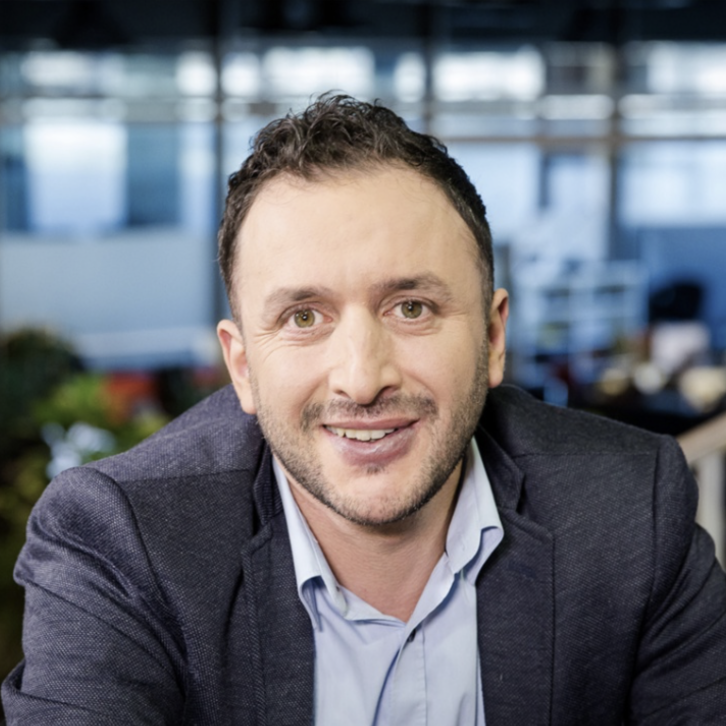
 Ernest Alesin
Vice-Chairman for International Affairs, Lithuanian Union of Journalists |
LITHUANIA
Short Bio: Ernest Alesin is the Vice-Chairman for International Affairs at the Lithuanian Union of Journalists. He has 30 years of professional experience in the media sector, including leadership roles in television, radio, print, film, and podcast production. Mr. Alesin actively contributes to strengthening media ethics, freedom of expression, and international cooperation. Since 2017, he has been involved in international programs supported by the UK Foreign, Commonwealth and Development Office and Baltic Centre for Media Excellence. Mr. Alesin is also the Head of the Association of Minority Media in Lithuania and currently, he is pursuing a Master’s degree in Sports and Tourism Management. Ernest Alesin is a Member of the Media Council under the Ministry of Culture of Lithuania, where he contributes to policy discussions on media diversity, media resilience, and the protection of minority voices in the public sphere.
Event: SDGs Conference 2025
Date: September 24, 2025
SPEECH: The SDGs Conference 2025 is taking place at a truly critical moment when the year 2025 marks the 30th anniversary of the Beijing Declaration and the 25th anniversary of the Women, Peace, and Security Agenda. It also coincides with the 80th Session of the United Nations General Assembly. These milestones remind us that while progress has been achieved, it remains fragile and must be advanced through leadership that is inclusive, resilient, and forward-looking.
I have spent more than 30 years in the media sector, and I have seen firsthand how societies, institutions, and narratives change. Just as journalism has been transformed by technology, globalization, and shifting values, so too must we recognize that the future of governance and civic engagement depends on transformation. The world around us is changing, and we must be ready to respond by solving today’s challenges and by building tomorrow’s solutions.
The panel “Women and Youth as Leaders for Civic Engagement and Social Change” focuses on the vital role of women’s leadership in shaping the future of the United Nations, the dangers posed by backlash against women’s rights, the urgent need to address intergenerational trauma, and the restoration of youth trust in inclusive governance and multilateral institutions. These are not abstract debates; they are questions that define the future of global governance and our capacity to achieve the Sustainable Development Goals.
I come from Lithuania, a country that, just twenty years ago, could hardly imagine the reality we live today. We had our first woman president, Dalia Grybauskaitė, whose leadership marked a turning point for the country. Today, women hold the highest offices: the Prime Minister is a woman, in fact, the second woman to hold this office in Lithuania, and they also serve as Ministers of Defense, Education, Justice, and Culture. Women chair parliamentary committees, lead banks, and run unicorn companies. Just a year ago, two of the three top positions of state, Prime Minister and Speaker of Parliament, were both held by women. Women also led the ministries of Finance and of Economy and Innovation. This is not an exception anymore. This has become the new normal. It has transformed the culture of governance, strengthened democracy, and built greater trust within society.
However, leadership is not only about women’s representation. We must also recognize the crucial role of youth leadership. In Lithuania, we see this in the work of school parliaments, where students practice democracy at an early age, and in LIJOT (the Lithuanian Youth Council), which brings together youth organizations from across the country to influence national policies. These are not symbolic exercises, but real platforms where young leaders learn responsibility, representation, and dialogue.
Across Europe and globally, youth leadership programs, from the UN Youth Delegates to the European Youth Parliament and many regional youth ambassador initiatives, are creating a generation of leaders who are courageous, innovative, and unafraid to challenge outdated structures. Their voices are essential if we are to renew multilateralism and ensure the future of inclusive governance. Throughout Europe and the world, women are also redefining leadership in times of crisis. Ursula von der Leyen, President of the European Commission, has carried the weight of COVID-19, the war in Ukraine, and the economic transformation of the European Union. Giorgia Meloni became the first woman Prime Minister of Italy, leading one of Europe’s largest economies. Kaja Kallas of Estonia has become a symbol of determination in the face of war. And Maia Sandu, the first woman President of Moldova, has led her country toward European integration despite immense external pressure and internal resistance.
These examples show us that leadership, both women’s and youth’s, is not simply a matter of equality. It is about resilience, building societies capable of withstanding crises, and ensuring that decisions reflect trust, diversity, and long-term vision. We must learn to look at people not through the categories of gender or age, but through the lens of their ideas and their ability to shape the future. The challenge before us is to recognize and elevate the solutions that will serve generations to come.