Short Bio: Dr. Martin Burt is a world-renowned social entrepreneur and microfinance pioneer who has developed two social innovations: the financially self-sufficient agricultural school model and the Poverty Stoplight, a new poverty metric and coaching methodology that is currently being implemented by more than 665,000 families and 1000 organizations in 60 countries. He is the Founder and CEO of Fundación Paraguaya, a social enterprise named Latin America’s most impactful and innovative development organization by the Inter-American Development Bank. In public service, Dr. Martin Burt has served as Chief of Staff to the President of Paraguay, was elected Mayor of the capital city of Paraguay, Asunción, and was appointed Vice Minister of Commerce. Dr. Burt has written books on economics, development, municipal government, poetry, and education. He holds a PhD from Tulane University.
Event: SDGs Conference 2025
Date: September 24, 2025
SPEECH: I have been working in poverty for more than 40 years, concentrating on street vendors with the microfinance movement. There must be a time when we got really frustrated because we did not understand how some street vendors came out of poverty, and some did not. Why did some people who increased their family income not fix their teeth or their bathroom? Why the promise of trickle-down economics by investing in the bottom of the pyramid sometimes worked and sometimes did not.
So, we looked at what the World Bank said about $3 per person per day, which did not match reality at all. Then we analyzed the Sustainable Development Goals. We asked the poor people with whom we work: “What does it mean for you to be not poor?”. They were ready to list us the requirements of having an income, clothes, nutritious food, drinking water, having adults and children to sleep in different bedrooms, education etc. And then they added: you must have a motivation, self-esteem, and be able to control your emotions. What is more important? Drinking water or controlling your emotions. The response was controlling emotions. There are no such subjective indicators among the SDGs, but we kept asking what is more important? Self-esteem or housing? The response was self-esteem. How do you measure poverty with subjective indicators?
We did a visual survey using three colors: green to represent non poverty, yellow to represent poverty, and red to represent ultra poverty. Any family in the world can self-diagnose their level of multidimensional poverty and come up not with an index that aggregates information for decision makers at the top, but a dashboard that disaggregates information for decision makers at the family household level. All these indicators that we were told, in addition to being objective and subjective, are actionable and achievable in five years.
We have now moved from having national development plans, municipal development plans to having family development plans for the world. At the family level, poverty can be eliminated in the short term. This is why we think that we must reconsider everything we are doing with the SDGs because they are third industrial revolution. With this current crisis, we are in the fourth industrial revolution, and now we have AI bots and avatars to coach every single family in their own language, in their own priorities. We are very encouraged with our work on the poverty stoplight. We are working in 14 States in the United States, in 100 communities in the UK. in addition to aroma communities in Bulgaria, Romania, Slovakia, in the favelas of Brazil, in the township of South Africa. At the family household level, change is possible. So, let’s hope that the fourth industrial revolution allows this.
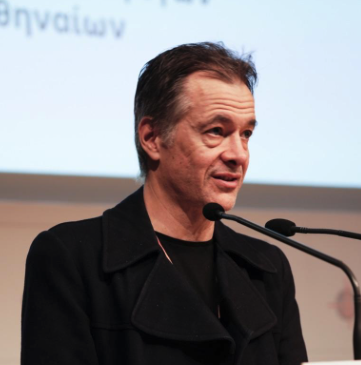
Vice Mayor for Social Integration of Migrants and Refugees, The City of Athens | GREECE
Short Bio: Hon. Mr. Thanassis Chimonas is the Vice Mayor for Social Integration of Migrants and Refugees at the City of Athens. He studied Literature and Film at the University of Strasbourg and Journalism in London. As a globally recognized author, his novels and short stories have been published in France, Germany, Israel, and North Macedonia, while he has also worked as a columnist for major media outlets such as Ta Nea, Athens Voice, Liberal.gr, and Fos ton Spor. Hon. Mr. Chimonas has also served as Secretary of Culture, parliamentary candidate for Athens A, and candidate for the European Parliament with political party, PASOK, as well as a member of the Political Council and candidate for the European Parliament with political party, To Potami.
Event: SDGs Conference 2025
Date: September 24, 2025
SPEECH: “We are living, dear friends, through very difficult times. This is not some cliché. We all witness it every single day. Bloody wars rage in every corner of the Earth: in Ukraine, in Gaza, in Sudan, and elsewhere. Hundreds of thousands of victims – among them a vast number of civilians, women, children, and the elderly – are paying the price of political and geopolitical choices they never made themselves. Political assassinations are back and shaking humanity. And the victims now belong not only to one faction or the other.
They span the entire ideological spectrum. Racism, intolerance, xenophobia, and racial and religious discrimination tend to become normalized. They are no longer marginal behaviors. They threaten to become definitively mainstream, part of everyday life.
We see mass demonstrations erupting in major European cities, not to defend solidarity or rights, but to declare hostility against migration. We see far-right and Alt-Right parties increasing their strength everywhere. In many countries, they are winning or about to win elections. And worst of all, these parties are often accepted as partners in governing coalitions, fully legitimized. Democracy, freedom of speech, human rights – all those things we took for granted for decades are under threat and shrinking. I will not hide behind generalities. I live in a country, Greece, which is ruled by an authoritarian and racist regime. We do not have a dictatorship, a junta like that of the colonels, in the dark period of 1967–74. We do not have tanks in the streets. The government of Mr. Mitsotakis was elected in the most democratic manner, with comfortable victories in two consecutive elections. Only, in 2025, authoritarian regimes are not installed through military coups. They are consolidated from within the very institutions themselves. They are born in parliament. They begin as elected governments and gradually restrict democracy, transforming it into a one-man democracy.
In the country where I live, most of the mainstream media is controlled. They were openly bribed during the pandemic under the pretext of so-called public information. Scandals follow one another, but ordinary citizens are often forced to search the internet to learn the details that the major channels conceal.
I will give you an example: Two and a half years ago, fifty-seven people perished in the deadliest accident in the history of Greek railways. And yet, this tragedy is being covered up with reports of dubious credibility. The relatives of the victims are mocked not only by the systemic media but also by armies of government trolls online. In my own field, that of migration, things are even worse. A few months ago, a politician with a heavy far-right past was appointed minister. He had been the leader of the youth wing of a pro-Nazi party in the 1980s and later the representative of the French Front National’s franchise in Greece. When this minister became embroiled in scandals, he was replaced by another politician of similar views, notorious for his far-right ideas and the son of perhaps the most important far-right ideologist in Greece – a man (the father) who, among other things, had written a book claiming that Jews are not humans.
The second minister did exactly what one would expect of him, exactly what he was placed there to do: he adopted a series of extreme racist measures, a disgrace not only for my country but also for the European Union, which insists on looking the other way. Imprisonment (under certain circumstances) of migrants and refugees without even examining whether they qualify for asylum. -a measure that applies to everyone, women with children, the elderly, and the disabled. Deportation, even for legal migrants who have lived in the country for years. Demonization – almost criminalization, of NGOs that work to provide aid to migrants and refugees. The Greek government has even boasted of deliberately worsening the quality of meals in migrant facilities, in order to make their lives unbearable.
Unfortunately, Greece is not an exception. It is an extreme example, but not unique. Similar phenomena can be found in many countries of the so-called “enlightened” West. Even in giants such as Germany, France, and the UK. The argument is always the same: “We must adopt some harsh measures so that the far right does not come to power.” But when you truly want to defeat the far right, you do not act like them. You do exactly the opposite. Otherwise, you become the far right yourself. Therefore, the problem is not only the regimes of Orbán, Meloni, or even Donald Trump. Conservatism existed and will always exist. The real issue is the parties that are elected under liberal or center-left banners, that promise to be bulwarks against the far right but ultimately become Trojan horses. It hurts me to admit this, but right now, the only ideological space that presents a coherent narrative is that of the “hardcore”.
What do we have to counter their flimsy and repulsive, yet seductive, arguments? The quota of actors in Hollywood films? How can we contribute to the integration of migrants and refugees when we are making cuts to everything that concerns them, as well as to culture, to education, under doctrines such as “Rearm Europe”? Because true inclusion is not achieved with weapons or with exclusions of the cancel-culture kind. It is achieved through culture, education, sports. Through play from the earliest age. We are obliged to stand against the racist, to fight him, not to fear him. But we will not wag our finger at the ordinary citizen who, perhaps influenced by the surrounding atmosphere and the misinformation of which he is also a victim, feels uncomfortable when he sees people around him who are different than him. This guy is not our enemy. He is a misled potential ally. And we must approach him with respect, listen to him, and convince him with arguments and truths.
We must come forward with ideas. With proposals. With a narrative that is not defensive but offensive. We must work with migrant communities, with civil society. We must put forward arguments of substance. We do not need, and must not, imitate our opponents with fake news or unethical methods. We have something far stronger: The truth. And it is enough to say it clearly, to shout it loudly.
The future, of course, appears bleak, dark, unpredictable. For many years, after the Second World War, humanity lived through a relatively calm period. It seemed that we had learned from the mistakes of the past. But all signs suggest that this is changing.
The Italian philosopher Antonio Gramsci once wrote: “The crisis consists precisely in the fact that the old is dying and the new cannot be born; in this interregnum a great variety of morbid symptoms appear.” Gramsci wrote this in prison, shortly before he died, when Italy was ruled by fascist dictator Benito Mussolini. And we all know what followed.
Today, we find ourselves once again in such an interregnum. Around us, the “morbid symptoms” multiply. Authoritarianism, disinformation, disappointment, and the sense of deadlock. We must, therefore, help this “new” to be born. To nurture it, to protect it, to bring it into the light. Before it is too late.
Short Bio: Honorable Ms. Epsy Campbell Barr is the Former Vice President of Costa Rica, and she was the first Afro-descendant and the first woman to be appointed as Minister of Foreign Affairs and Worship. Ms. Barr is a global leader in inclusion, development, human rights, and sustainability. She was also twice elected as a congresswoman of the Republic of Costa Rica. Ms. Barr is an Independent Expert of the United Nations and a promoter of business and employment opportunities in new technologies and cybersecurity for people from historically marginalized sectors. From 2021 to 2024, she was the President of the United Nations Permanent Forum of Afrodescendants. As an international activist, she founded the Global Coalition Against Systemic Racism and for Reparations, a large international organization that develops actions in countries to combat racism through art, culture, and education.
Event: SDGs Conference 2025
Date: September 24, 2025
SPEECH: We gather at a time when humanity stands at a crossroads, as there are poverty and exclusion around us; scarcity in the lives of billions, as entire populations fear war and extermination. We witness the impression of power that denies people their voice, while the institution of multilateralism, built to ensure peace and cooperation, is strained and weakened. Racism continues to divide and dehumanize. Sexism and systemic exclusion of women prevent humanity from truly contributing to our share of the future. Resources are concentrated in a few, while millions remain trapped in a circle of poverty. The climate crisis is no longer a distant threat; it is here. The vast communities from the Caribbean, from the Pacific Islands to the Arab world, our democracies are fragile, often unrepresentative of the needs and aspirations of the people.
We are not merely living through a crisis. We are living in a change of era. The global crisis is not only economic; it is social, environmental, and cultural. It is a crisis of leadership and civilizational values. It is too often that the leadership today is built on individualism and ruthless competition. Patriarchal communities are accommodating wealth, resources, and empowered without concern of the common good. It is extractive, even predatory, consuming the earth’s resources without caring for the future generation. It is a leadership that embraces the doctrines to justify the means. A leadership that excludes diversity, rather thrives on violence and confrontation that denies the dignity of those who are different. This is the model of leadership that has brought us to the edge where survival itself is at stake.
Despite this challenge, humanity has a shared compass, which is the Sustainable Development Goals (SDGs) adopted by all nations. The SDGs represent more than a checklist. It is a common agenda to guarantee rights for all people, to build peace, equality, and sustainability. The goals remind us that development must mean eradicating poverty in all forms, ending hunger, and ensuring dignity through access to health and education. It ensures gender equality not as a favor for women, but as a necessity for humanity. They are protecting our planet, oceans, forests, biodiversity, because there is no plan B and no planet B. SDGs are ensuring that women and men share power and responsibility in equal measure at every level of decision making. The SDGs are about translating promises into lived realities. They are about ensuring that no one is left behind because, more than a slogan, it becomes the measure of our collective consensus.
Let us be clear: a promise, no matter how noble, is not enough. Commitments on paper do not feed hungry children, do not heal our wonder planet, and do not empower silenced voices. We must go beyond rhetoric and good intentions. Delivering on the SDGs means building political will, allocating resources, strengthening institutions, and holding ourselves accountable. It means aligning the energy of civil society, the innovation of the private sector, and the responsibility of governments. It requires courage, the interest to redistribute resources, and to stand firmly for human rights. Yes, this is a time of extraordinary challenge, but it must also be a time of collective and joint actions. We are called to be part of what I call the shining generation. A generation that refuses to surrender the despair and still transforms pain into labor of birth, as with childbirth, the deeper the pain, the closer we are to bringing it into life. Despite the intensity of today’s crisis, we are closer than ever to delivering a new era of peace, justice, and sustainability. That is why each of us, wherever we are, must promote change. Starting with the immediate impact we can make in our communities, in our institution, and in our own leadership. We cannot despair and fail to take hold. The SDGs call us to act now and known more than clearly that Goal 17 is to strengthen coordination and partnership across all the sectors, all the identities, and all the people. Only together in unity can we transform the promise into a reality to finish the task.
We must also change how we lead. The future will not be secure with the same leadership that created today’s crisis. We need a new leadership that is transformative and compassionate, that chooses cooperation over confrontation. Inspire through example, not fear. Listen deeply, especially to the voices that are long ignored. Operate with a clear framework of principles and values. Understand and live the principle of Ubuntu: I am because we are. This is the leadership that nourishes and protects, that heals and restores. It is a leadership that embodies the strength with empathy, care, and collaboration. It is a leadership that knows strength lies in lifting others up. And it is a leadership that brings self-leadership, the capacity to go beyond one’s own ego. They cultivate humility to align personal conduct with universal values. Without self-leadership, we cannot lead orders with integrity.
The task before us is urgent but not impossible. The sustainable development goals are promises we made to the poor, to excluded ones, to the planet, to the future generation. That promise must be kept, but promises are only fulfilled when people, leaders, the community, and each of us decide to act. The SDGs are not the responsibility of the governments alone. They are the responsibility of all humanity. So let us leave this conference with a renewed determination to act together across borders, culture, and generations. Let us embody a new leadership that is both bold and compassionate. Let us make the principle of Ubuntu real in our life. At the end of the day, our lives are intertwined. My humanity is bound up with yours. Your future is linked to mine, and only together only as a human family, can we finish the task. Let us deliver the promise of Sustainable Development Goals. Let us ensure justice, sustainability, and dignity for every person, everywhere.


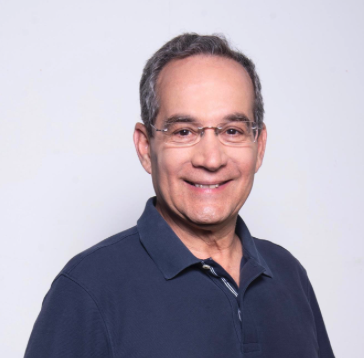 Dr. Martin Burt

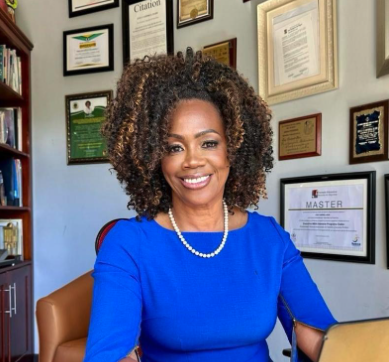 H.E. Epsy Campbell Barr