
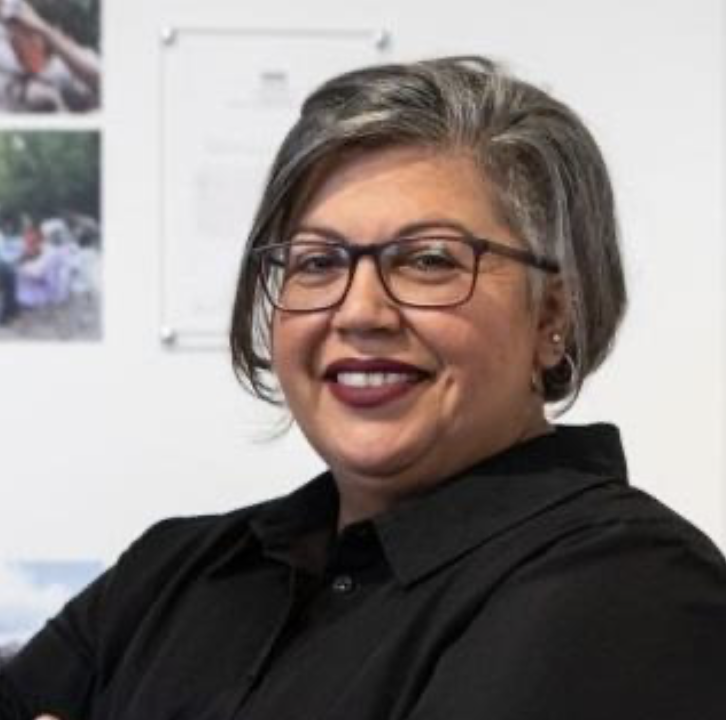
 Adla Shashati
Director, Greek Forum of Migrants | GREECE
Short Bio: Ms. Adla Shashati is the Director of the Greek Forum of Migrants. She is a journalist and social activist with roots in Sudan and Greece. She holds a degree in Media and Cultural Studies and a postgraduate degree in New Media Technologies. Passionate about social justice, Adla has been actively engaged in efforts against racism and xenophobia at both the national and European levels. She has represented Southern European countries in the Board of the European Network Against Racism and currently serves on the Steering Committee of Equinox, Initiative for Racial Justice. Her advocacy focuses on inclusion, equality, and building cohesive societies that rely on care and not punishment. Ms. Adla Shashati has participated in conferences and public dialogues, highlighting the importance of inclusion and participation of migrants in the social dialogue to strengthen social prosperity and combat institutional racism.
Event: SDGs Conference 2025
Date: September 24, 2025
SPEECH: As the Director of the Greek Forum of Migrants, I will address an issue deeply rooted in many of our communities, how intergenerational trauma can be mitigated, and the mental well-being of youth and women protected in times of conflict. More specifically, when I refer to intergenerational trauma, I refer to the transmission of trauma across generations, shaping identities and mental health long after conflict ends, and the way it is being addressed along with other issues in grassroots-level work.
Before I proceed, I would like to introduce you to the work done by my organization, which is a work done by grassroot, migrant led communities. The Greek Forum of Migrants (GFM) is a network of migrant and refugee organizations across Greece. We operate as a union since 2002, and GFMs members and the Board of Directors are exclusively representatives from migrant and refugee communities. Currently, our network numbers 44 organizations from Africa, Asia, Eastern Europe, the Middle East, including other associations and networks. We envision a society where migrants enjoy equal rights, fair treatment, and social inclusion. We deliver projects focused on equal rights, social cohesion, empowerment, and combating discrimination.
What do we have to face in Greece? Mainly, what most of the migrant communities are facing nowadays. The migrant population in Greece is approximately 600.000, and around 300.000 European migrants. The migrant population in Greece is composed of 501.093 third-country nationals, 90.174 beneficiaries of international protection, according to the info by the Greek Ministry of Migration and Asylum in May 2025.
The current challenges these people face are the following:
- Criminalization of migration: The new law criminalizes undocumented migrants. If you are found without papers, you are immediately imprisoned and face deportation. It does not matter if you are 30 years in the country or if you came yesterday.
- Invisibility for the state: Residence permits are issued expired because it takes too long to issue them, and the Greek reality is full of bureaucratic obstacles that create difficulties for the vulnerable communities. Today, more than 293.000* of our fellow citizens are still waiting for the renewal or the first issue of their residence permit. (*Greek Ministry of Migration & Asylum – May 2025)
- No integration policy: Thousands of refugees who gained asylum face homelessness due to policy gaps in integration and shelter programs. This also reflects on the immigrant population. There are no state schools for learning the Greek language; if you are lucky, the Municipality will have a school, or your community will have volunteer teachers.
- Danger: Especially vulnerable groups include survivors of gender-based violence, people with mental health issues, single women or single-parent families, and young adults. People who have faced traumatic experiences are being traumatized again through a different process. And it takes even more time to heal.
Impacts of trauma include personal and communal effects. We have seen that youth exposed to conflict may experience anxiety, depression, PTSD, and barriers to education and community integration. On the other hand, women face compounded stress, from caregiving burdens and trauma to gender-specific challenges such as violence and exclusion. The psychological approach requires time and attention. So, the re-emergence of the traumas suffered can be a long and difficult process. It cannot go away in a day. It needs time, and the states do not seem to care to provide this time. Moreover, they are putting more obstacles to vulnerable communities.
In Greece we are facing a systemic fallout due to the lack of a holistic approach to migration policies, migrants in Greece face a repetition of trauma in their everyday life. A trauma that reflects throughout generations (birth, school, regularization process, employment, and even death). Without proper support, trauma becomes entrenched across generations, weakening the social fabric. The support we try to give relies mostly on care and safety.
Pathways to Healing and Mitigation:
Community Support and Safe Spaces: Our Community-led groups and forums offer places of belonging and mutual support, which are fundamental for beginning healing. We try to address the lack of information | marginalization, and exclusion through several tools inside the communities, including safe spaces, which are places of care created and run voluntarily by migrant community-led groups.
We provide free and valid Information: the GFMs Summer Guide initiative offered vital services for health (including mental health), psychosocial support, legal aid, and job assistance for migrants & refugees in Athens. We also have an INFODESK initiative, which operates daily in GFM as an information office with referrals from and for migrants.
Moreover, we believe that there should be inclusive access to mental health services. Mental health care must be integrated into broader service provision, especially for single women and youth with trauma-related vulnerabilities. There is an extreme need for culturally sensitive, language-accessible mental health services, embedded in trusted community spaces. Every day, we receive calls from doctors & social workers to support them with translation, home support, or even care during patients’ cancer treatments. We create multi-language guides about gender-based violence, reporting hate crimes etc.
We also try to provide empowerment through integration, as GFM encourages policies that extend beyond emergency aid to long-term community support -housing, work, and social integration. In one of the pillars that we work which we call NEW CITIZEN, we have P2P training, for community representatives to lead and train others inside their community. GFM’s advocacy relies on legal inclusivity, fair migration law, and access to social services as critical to mental health recovery and prevention of destitution in collaboration with the community`s leaders to represent themselves.
Other important tools are education, leadership, and skill building. We have youth-focused programs with language classes, workshops, and leadership training, building resilience, self-esteem, and future orientation. There are also women’s empowerment initiatives with economic, educational, and psychosocial programs that restore agency and reduce trauma cycles. We are very proud of the work and efforts done by our women`s group, including United African Women Organisation, Nigerian Women Organisation of Greece, and Migrant Women Network.
The Role of Civil Society and Collective Action:
At the Greek Forum of Migrants, we recognize that healing and inclusion demand collective effort. We must unite governments, civil society, and migrant-led organizations, with migrants taking the lead in advocacy and empowerment. What is important is to emphasize migrant-led initiatives, informed by lived experience and community insight, as catalysts for sustainable inclusion. Trauma from conflict can echo for generations but so can healing. By investing in culturally informed mental health services, equitable policies, solidarity, community, and empowerment of youth and women, we can break intergenerational cycles.”
Call to Action could refer to the following:
- Treat mental health as an urgent, non-negotiable aspect of refugee and migrant policy.
- Champion inclusive integration, housing, psychosocial services, legal access.
- Elevate youth and women through leadership, education, and support programs.
- Support already-existing grassroots organizations and projects.
Together, we can ensure that future generations inherit resilience, hope, and the strength to thrive.