
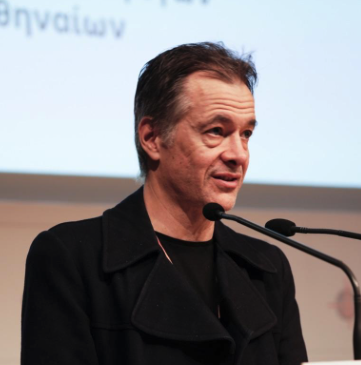
Hon. Mr. Thanasis Chimonas
Vice Mayor for Social Integration of Migrants and Refugees, The City of Athens | GREECE
Short Bio: Hon. Mr. Thanassis Chimonas is the Vice Mayor for Social Integration of Migrants and Refugees at the City of Athens. He studied Literature and Film at the University of Strasbourg and Journalism in London. As a globally recognized author, his novels and short stories have been published in France, Germany, Israel, and North Macedonia, while he has also worked as a columnist for major media outlets such as Ta Nea, Athens Voice, Liberal.gr, and Fos ton Spor. Hon. Mr. Chimonas has also served as Secretary of Culture, parliamentary candidate for Athens A, and candidate for the European Parliament with political party, PASOK, as well as a member of the Political Council and candidate for the European Parliament with political party, To Potami.
Event: SDGs Conference 2025
Date: September 24, 2025
SPEECH: “We are living, dear friends, through very difficult times. This is not some cliché. We all witness it every single day. Bloody wars rage in every corner of the Earth: in Ukraine, in Gaza, in Sudan, and elsewhere. Hundreds of thousands of victims – among them a vast number of civilians, women, children, and the elderly – are paying the price of political and geopolitical choices they never made themselves. Political assassinations are back and shaking humanity. And the victims now belong not only to one faction or the other.
They span the entire ideological spectrum. Racism, intolerance, xenophobia, and racial and religious discrimination tend to become normalized. They are no longer marginal behaviors. They threaten to become definitively mainstream, part of everyday life.
We see mass demonstrations erupting in major European cities, not to defend solidarity or rights, but to declare hostility against migration. We see far-right and Alt-Right parties increasing their strength everywhere. In many countries, they are winning or about to win elections. And worst of all, these parties are often accepted as partners in governing coalitions, fully legitimized. Democracy, freedom of speech, human rights – all those things we took for granted for decades are under threat and shrinking. I will not hide behind generalities. I live in a country, Greece, which is ruled by an authoritarian and racist regime. We do not have a dictatorship, a junta like that of the colonels, in the dark period of 1967–74. We do not have tanks in the streets. The government of Mr. Mitsotakis was elected in the most democratic manner, with comfortable victories in two consecutive elections. Only, in 2025, authoritarian regimes are not installed through military coups. They are consolidated from within the very institutions themselves. They are born in parliament. They begin as elected governments and gradually restrict democracy, transforming it into a one-man democracy.
In the country where I live, most of the mainstream media is controlled. They were openly bribed during the pandemic under the pretext of so-called public information. Scandals follow one another, but ordinary citizens are often forced to search the internet to learn the details that the major channels conceal.
I will give you an example: Two and a half years ago, fifty-seven people perished in the deadliest accident in the history of Greek railways. And yet, this tragedy is being covered up with reports of dubious credibility. The relatives of the victims are mocked not only by the systemic media but also by armies of government trolls online. In my own field, that of migration, things are even worse. A few months ago, a politician with a heavy far-right past was appointed minister. He had been the leader of the youth wing of a pro-Nazi party in the 1980s and later the representative of the French Front National’s franchise in Greece. When this minister became embroiled in scandals, he was replaced by another politician of similar views, notorious for his far-right ideas and the son of perhaps the most important far-right ideologist in Greece – a man (the father) who, among other things, had written a book claiming that Jews are not humans.
The second minister did exactly what one would expect of him, exactly what he was placed there to do: he adopted a series of extreme racist measures, a disgrace not only for my country but also for the European Union, which insists on looking the other way. Imprisonment (under certain circumstances) of migrants and refugees without even examining whether they qualify for asylum. -a measure that applies to everyone, women with children, the elderly, and the disabled. Deportation, even for legal migrants who have lived in the country for years. Demonization – almost criminalization, of NGOs that work to provide aid to migrants and refugees. The Greek government has even boasted of deliberately worsening the quality of meals in migrant facilities, in order to make their lives unbearable.
Unfortunately, Greece is not an exception. It is an extreme example, but not unique. Similar phenomena can be found in many countries of the so-called “enlightened” West. Even in giants such as Germany, France, and the UK. The argument is always the same: “We must adopt some harsh measures so that the far right does not come to power.” But when you truly want to defeat the far right, you do not act like them. You do exactly the opposite. Otherwise, you become the far right yourself. Therefore, the problem is not only the regimes of Orbán, Meloni, or even Donald Trump. Conservatism existed and will always exist. The real issue is the parties that are elected under liberal or center-left banners, that promise to be bulwarks against the far right but ultimately become Trojan horses. It hurts me to admit this, but right now, the only ideological space that presents a coherent narrative is that of the “hardcore”.
What do we have to counter their flimsy and repulsive, yet seductive, arguments? The quota of actors in Hollywood films? How can we contribute to the integration of migrants and refugees when we are making cuts to everything that concerns them, as well as to culture, to education, under doctrines such as “Rearm Europe”? Because true inclusion is not achieved with weapons or with exclusions of the cancel-culture kind. It is achieved through culture, education, sports. Through play from the earliest age. We are obliged to stand against the racist, to fight him, not to fear him. But we will not wag our finger at the ordinary citizen who, perhaps influenced by the surrounding atmosphere and the misinformation of which he is also a victim, feels uncomfortable when he sees people around him who are different than him. This guy is not our enemy. He is a misled potential ally. And we must approach him with respect, listen to him, and convince him with arguments and truths.
We must come forward with ideas. With proposals. With a narrative that is not defensive but offensive. We must work with migrant communities, with civil society. We must put forward arguments of substance. We do not need, and must not, imitate our opponents with fake news or unethical methods. We have something far stronger: The truth. And it is enough to say it clearly, to shout it loudly.
The future, of course, appears bleak, dark, unpredictable. For many years, after the Second World War, humanity lived through a relatively calm period. It seemed that we had learned from the mistakes of the past. But all signs suggest that this is changing.
The Italian philosopher Antonio Gramsci once wrote: “The crisis consists precisely in the fact that the old is dying and the new cannot be born; in this interregnum a great variety of morbid symptoms appear.” Gramsci wrote this in prison, shortly before he died, when Italy was ruled by fascist dictator Benito Mussolini. And we all know what followed.
Today, we find ourselves once again in such an interregnum. Around us, the “morbid symptoms” multiply. Authoritarianism, disinformation, disappointment, and the sense of deadlock. We must, therefore, help this “new” to be born. To nurture it, to protect it, to bring it into the light. Before it is too late.