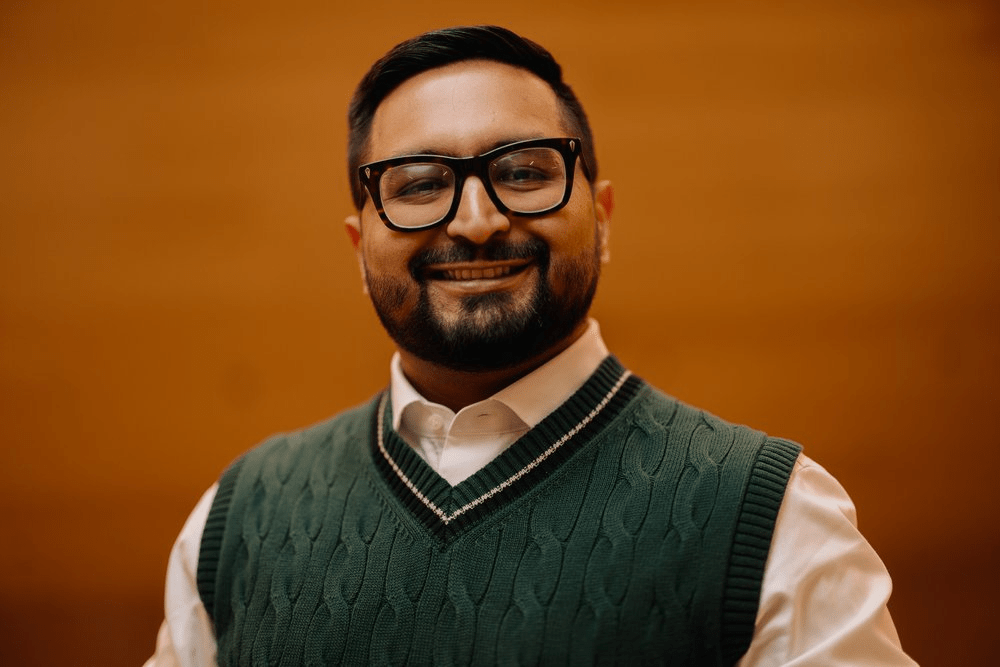
Anil Wasif is a policy researcher and practitioner with extensive experience in government and non-profit sectors. He is Co-founder, Trustee & Director of Strategy of BacharLorai, a non-profit focused on empowering Bangladeshis worldwide. He is also a Research Manager at Infrastructure Ontario. Mr. Wasif was formerly Senior Economist at the Office of the Budget, Ministry of Finance and Senior Policy Advisor to the Associate Deputy Minister, ServiceOntario. Mr. Wasif serves on the Advisory Board for the Max Bell School of Public Policy at McGill and the Governing Board at the University of Toronto Mississauga. He is also a Senior Fellow at Bangladeshi Canadian Community Services. He holds a Master’s in Public Policy from McGill University and a Bachelor’s in Economics and Political Science from the University of Toronto.
Event: SDGs Conference 2024
Date: Sept 25, 2024
SPEECH
My remarks will focus on one point only: how do you design an organization that empowers young people to take charge? I am a citizen of the world, who is in charge of Strategy at BacharLorai. BacharLorai is a Bangla word that means strive to survive. Bangla is a language spoken by over 180 million people in Bangladesh and over 20 million members of the Bangladeshi diaspora worldwide. We, the people of BacharLorai, have a mandate to empower these communities worldwide through community-building events, research publications, and humanitarian work.
Community building aligns most strongly with sections 4, 14, and 15, which focus on building international cooperation, fostering youth participation, and creating partnerships.
Policy Research aligns with sections 23, 24, and 57, providing evidence-based research and analysis that supports poverty reduction, gender equality, and humanitarian cooperation.
Signature Initiatives finds alignment with sections 15, 23, and 57, focusing on youth leadership, economic opportunities, and humanitarian aid.
You will notice that, by design, our organization advocates for the Pact of the Future. However, after attending the Summit of the Future and subsequent meetings at the UNGA and listening to my distinguished colleagues at the SDGs Conference, I have also realized that implementation starts today. Every single project launched under our three pillars is tied to one specific SDG and sub-targets. This not only helps us promote the SDGs, but helps the entire team, including senior members of the Board learn about them, and continuously remember them as a guide to our work. Today we are a team of 16 people, working from Dhaka, Toronto, New York City, Washington DC, and London. Over half the team identify themselves as women and over 60% are Gen Z. But my work on this continues every day. This past year, we have successfully delivered 36 youth-led projects, secured over $15,000 in financial support, and volunteered over 10,000 hours to benefit 1500 people in the world.
The academic term for what we do is called Digital Social Innovation; what we like to call is using technology to transform passion into tangible action. I am very happy to say, we stand as the only non-profit organization that actively engages citizens from around the world, from all backgrounds, to empower Bangladeshis globally. We have disrupted the traditional non-profit space by hosting engaging social events that bridge the gap between having a good time and doing good in this world; channeling input from those events into publishing thought-provoking research and launching local aid initiatives backed by that evidence. That’s our strategy and we invite you to replicate it. At BacharLorai, youth leadership is at the core of our identity. Every event we have hosted has featured young speakers showcasing their ideas, initiatives, and solutions. Whether they are on stage or behind the scenes, every individual is contributing to real-world change.
We ensure young people in our organization get maximum visibility and that their input is considered seriously. Thus, our talent strategy ensures that young professionals are not only equipped with the tools they need to lead but are active participants in strategic planning. We seek their input on decision-making processes and ensure full transparency, even our financial statements are accessible to all team members. This strategy is proven and replicable, preparing young people for leadership roles far beyond BacharLorai.
For next year, we are building a People-First Strategic Plan, channeling input from our public-facing events, conferences, staff passions, and leadership opinions. This will decentralize power, allowing each of our nine program managers to deliver their projects with full autonomy, targeting revenue from diverse funding sources such as crowdfunding, corporate gifts, and individual donations. This approach empowers leaders to be creative, innovative, and accountable for their results. During the pandemic, the hashtag model was effective, but it was not sustainable for the long-term. As a leader, I realized that to scale our work while remaining resource-efficient, we needed to build mechanisms for sustainability.
Today, BacharLorai is focused on creating long-term impact through diversified funding streams and strategic partnerships with governments, non-profits, and the private sector. These partnerships not only enhance our reach but allow us to drive systemic change. One of our proudest achievements is the rigor of our reporting standards. For any cross-border aid initiative, we operate with one of the most rigorous accountability systems in the world. This includes securing confidential contact information for aid recipients to ensure every donation reaches its intended beneficiary. These measures build trust with our donors and communities, ensuring that every contribution is fully transparent and traceable.
We are also the only organization (in this space) that channels insights from social events into a structured research agenda. Our ability to translate community input into actionable research allows us to not only engage but inform policies and decisions at a higher level. This reinforces the trust we’ve built with our community and helps us influence systemic change through advocacy, policy work, and global partnerships. Nonprofits face unpredictable challenges, and our resilience has been tested many times. Whether it was navigating the complexities of the pandemic or adapting to shifting geopolitical landscapes, BacharLorai has shown its ability to be agile.
We did this through forging international relationships and meeting our partners at every step of the way. We are committed to being responsive to the needs of the communities we serve while remaining adaptive to global trends. BacharLorai is more than a non-profit, faster than a charity, and cooler than a think tank; we are an agency for young leaders to take charge of their future. From our decentralized leadership model to our rigorous reporting standards, we are setting an example for what is possible when youth are empowered to lead.
We believe in transparency, innovation, and most importantly, delivering excellence. Our work is an invitation to young people everywhere to replicate our strategy and do better in the world.
Jesselina Rana serves as the United Nations Advisor at CIVICUS New York Hub, where she spearheads research and analysis in international law and policy, advocates for civil society participation, and advises on global trends concerning civic space issues from a multilateral and global governance perspective. By engaging closely with member states, UN personnel, and Civil Society Organizations, Ms. Rana actively collaborates with civil society partners in New York and beyond to drive transformative changes in civic space and civil society engagement at the international level. Jesselina Rana holds a master’s degree in law from Harvard Law School.
Event: SDGs Conference 2024
Date: Sept 25, 2024
SPEECH
CIVICUS is a global alliance of civil society organizations dedicated to protecting civic freedoms worldwide and it is headquartered in Johannesburg, South Africa. I would like to provide a brief overview of CIVICUS and share some reflections on the Summit of the Future and the Pact for the Future. One of our key initiatives is our annual participation research publication called the CIVICUS Monitor, where we track civic ratings globally and analyze trends in civic freedoms. In 2023, our data revealed that only 2% of the global population lives in countries classified as having open civic spaces.
Unfortunately, this situation is well-known to the UN. Civil society faces various multi-layered challenges at the UN, ranging from physical and digital access to meaningful participation. Yet, civil society has always been a vital force for change, playing a crucial role in developing and advocating for more inclusive rights-based international policies at the UN. From the Beijing Declaration and Platform for Action to the Sustainable Development Goals, civil society has consistently championed commitments to inclusivity and accountability in international agreements. However, just as civic space is shrinking globally, access to civil society within the UN has regrettably been narrowing as well.
CIVICUS has viewed the process of engaging with the Pact for the Future with cautious optimism. We have invested substantial time and effort in attempting to shape the Summit’s processes and outcomes. However, we believe that the diplomatic negotiations on the Pact for the Future have been hampered by disagreements over language. Several forward-looking proposals from civil society found little traction in the final pact adopted on 22 September 2024. Regrettably, we also witnessed the removal of language regarding human rights defenders. After extensive advocacy, we now see the language on civic space protection in the final version, but interestingly, the Global Digital Compact features a more diluted version on the promotion of civic space online. As part of our recommendations, we made three innovative suggestions for the Pact for the Future, including a Human Parliamentary Assembly, a World Citizens Initiative, and a civil society envoy to better connect people’s needs and aspirations to the UN. Unfortunately, these proposals did not make it into the final Pact.
That stated we do recognize the value of the Pact for the Future`s acknowledgment of the human rights pillar as an equal, interlinked, and mutually reinforcing component of the UN. We also appreciate the request for the UN Secretary-General to assess the need for an adequate, predictable increase in sustainable funding and financing for UN human rights mechanisms, including the Office of the United Nations High Commissioner for Human Rights. Currently, the human rights pillar receives only about 5% of the UN’s regular budget.
H.E. Dr. Hajo Sani Oon Ambassador, Permanent Delegation of Nigeria to UNESCO | Nigeria
Short Bio:
Dr. Hajo Sani Oon is an Educationist and Policy Analyst with extensive experience in teaching and public administration. She holds degrees in Education, Guidance and Counseling, and Public Administration. Dr. Sani served as a school principal for twelve years and as Minister of Women Affairs from 1997 to 1998, where she defended Nigeria’s CEDAW reports at the UN. She authored influential books on women’s issues, including “Women and National Development: The Way Forward” (2001), and founded the NGO Women and National Development (WAND).
Her other notable works include “First Ladyship and Empowerment Programmes in Nigeria” (2010) and “Women and Leadership” (2012). She has been active in various committees, including the UN Women Civil Society Advisory Group (CSAG), and received the Officer of the Order of the Niger (OON) in 2006. Dr. Sani worked with the Society for Family Health (SFH) and the Bill and Melinda Gates Foundation and was appointed Senior Special Assistant to the President on Women Affairs in 2015. In 2021, she became Nigeria’s Ambassador and Permanent Delegate to UNESCO in Paris.
Event: SDGs Conference 2024
Date: Sept 25, 2024
SPEECH
Excellencies, fellow panelists, colleagues, distinguished ladies and gentlemen. Let me start by expressing my appreciation to the Journalists and Writers Foundation for inviting me to speak at the annual SDGs Conference 2024 on the role of education in achieving the Pact for the Future. My reflections will be on what the Pact aims to achieve. How did we get here from the SDGs dispensation and what is the role of education?
We cannot speak about the Pact of the Future in isolation from Agenda 2030 for Sustainable Development and the 17 distinct but interworking development goals. SDG 4, spearheaded by UNESCO, aims to ensure inclusive, equitable, and quality education, promoting long-life learning for 10 targets covering primary and secondary education to increase the supply of qualified teachers in developing countries. Despite some progress, the agenda is currently behind on its commitments while implementation experience brought the realization that education remains a major factor in achieving the other goals. Furthermore, the SDG 4 objectives have been met with more unexpected negative experiences, especially the COVID-19 pandemic, global conflicts, financial crisis, and inflation with devastating impacts on education, particularly the learning process.
The midterm reality informed the United Nations Secretary-General Antonio Guterres to put the SDGs back on track starting from realizing Our Common Agenda, the Transforming Education Summit and Pact for the Future are the latest in the series setting the tone for the agenda beyond 2030. Although education is not a standalone action in the Pact, all 58 points demonstrate its importance to achievement. Education has and will continue to play a significant role in sustainable development. Therefore, to address the role of education in the Pact for the Future, I would dwell on four points. First, how the educational policies can be better designed to ensure gender equality and empower women and girls as a follow-up to the commitments. Action number eight in particular aims for gender equality, the empowerment of all women and girls across all SDGs and targets.
This is also in line with SDG 5 whose objective is to streamline the educational system for gender focus programs benefiting students and learners of all ages and grades. Let me draw attention to UNESCO`s transforming mentalities program, which promotes lifelong learning in civic and gender education with men taking the lead as advocates. Under this scheme, members are encouraged to develop programs for life skills and social transformation. Others are accelerating girls’ enrollment, lifelong gender learning, and incentives for women to take an interest in STEM education and profession as well as leadership roles. Implementing the Pact for the Future should emphasize the following mention: promoting gender equality should start by upgrading and updating the national curriculum for girls’ and women’s empowerment and gender-sensitive education at all levels.
What strategy can be employed in the education system to align with the SDGs as outlined in the Pact and the 58 actions embodied in the SDGs? They address further threats to achievements such as protecting education during emergencies, economic empowerment and social cohesion in uncertainties, and adapting to new emerging technologies. UNESCO’s program on education for sustainable development provides a clue to a system that aligns components such as environmental, development, and global citizenship education. The recently adopted recommendations on education for peace and human rights are gender equality in the digital area. They prescribe education systems that effectively improve resilience to climate-driven crises, dealing with their precautions while not causing further damage to the planet. Global citizenship education is essential to prepare learners who value human dignity, cooperation, and dialogue to have a new understanding of peace as not just the absence of violence and conflicts, but also a positive and dynamic process that nurtures the ability to value coexistence and take care of the planet. These are pointers to the right strategy.
My next highlight is the primary challenges in implementing educational policies that support the SDGs and commitments of the Pact for the Future. The functional curriculum regarding the SDGs-related life skills is a challenge. Teachers are in short supply, lacking professional development opportunities, low status and working conditions, and capacity to develop leadership, autonomy, and innovation. Another alarming issue is education in conflict and emergencies where instabilities of stroke learning, including those resulting from war, climate change policies to support sustainable development must improve the station of teachers’ responsiveness to emergencies with innovative and community-based approaches and lifelong cognitive learning.
What future-oriented strategy should be prioritized in the educational system to ensure they contribute effectively to the long-term Sustainable Development Goals? We must focus on teaching sustainability from the youngest age, nurturing environmentally conscious learners, and a new set of global citizens who have not only academic success but are trained to take personal responsibilities. Lastly, since all education initiatives will be void in the face of limited access, deploying new and emerging digital technologies to improve access to holistic education should be a priority. This will include cooperation to overcome the barriers of the digital divide and to build the capacity of disadvantaged regions for connectivity and digital equipment for equity.
President of the Institute for Ecological Civilization
Professor Philip Clayton Ingraham Professor, President, Institute for Ecological Civilization | USA
Short Bio:
Prof. Philip Clayton is the President of the Institute for Ecological Civilization. As a visionary thinker, Prof. Clayton leads EcoCiv in expanding and deepening its mission at the intersections of environment and humanity. With several decades of experience in university-based research, teaching, and lecturing, Prof. Clayton is involved in the conceptual development of all EcoCiv’s projects and ensures mission fit. He assists project leaders about intersectional societal changes relevant for their particular projects. Prof. Clayton holds a PhD from Yale University; has held guest professorships at Harvard, University of Cambridge, and University of Munich. He is the author and editor of several dozen books and over 300 articles on science, ethics, religion.
Event: SDGs Conference 2024
Date: Sept 25, 2024
SPEECH
I open with warm thanks on behalf of all the participants to our hosts and to the Journalists and Writers Foundation for organizing this year’s meeting. I first met with leading writers and journalists from JWF over a decade ago in Istanbul. Today we celebrate almost a decade of JWF support for the Sustainable Development Goals at the United Nations. Although many do not recognize it, there is a useful barometer for assessing our overall progress on the SDGs. In the good years, we are laser-focused on the details of implementing specific programs within a single SDG (or several together).
These are the seasons of optimism and progress. You can watch the global community rolling up its collective sleeves and solving the difficult challenges in particular areas. When on-the-ground changes are being made and outcomes are measurable, there is energy and hope. In my organization, EcoCiv, we saw this productivity during our consultation on the urban water crisis in Cape Town just before COVID-19; we saw it more recently as we helped the NGO Water for South Sudan launch its new Water Institute last year.
As you know from the SDG reports in 2023 and 2024, this is not one of those moments. The famous words of António Guterres are echoing in our ears: “Unless we act now,” he said, “the 2030 Agenda will become an epitaph for a world that might have been.” Indeed, many of us heard a similar message from the Environment Minister of Samoa, Cedric Schuster, in her interview just two days ago. Speaking as Chair of the Alliance of Small Island States, Minister Schuster worried that [fingers] “our countries are moving further and further away from the unity and moral fortitude that we require to protect our people.” She then said the truth bluntly: “The vulnerable people of our world are drained by lip service.” With six years to go, with many of the metrics heading in the wrong direction, and with wars expanding, there is no doubt about the gravity of this moment.
Fortunately, it’s the tradition of this series of SDG summit meetings not to dwell in darkness, but instead to look for where the hope lies … and to listen and learn as global experts in the specific SDGs identify the pathways to get us there. We will hear innovative ideas, novel solutions, and calls to action in the three panels that follow. In preparation for the work that lies ahead of us today, and in the years to come, I offer three images as a framework for these discussions.
Dark times require a guiding light. Today every study underscores the widening disparity between the nations that are contributing most to global warming and those who are suffering its worst effects. There is no longer any doubt: the climate crisis is not “just” an environmental issue; it’s a matter of global justice. So let this be our guiding light in dark moments: Global justice is the starting point of our SDG work and the final destination of all our specific initiatives. The light of justice does shine in the darkness, and the darkness shall not overcome it. We turn our eyes to the future to direct our steps today. Four days ago, Assembly President Philémon Yang lowered his gavel at the General Assembly, and the Pact for the Future became a United Nations consensus statement.
Hear the words: “The Heads of State and Government, representing the peoples of the world, gathered at UN Headquarters, to protect the needs and interests of present and future generations, through the actions in this Pact for the Future.” It is a Pact for “all those generations that do not yet exist and who will inherit this planet.”
We labor for the SDGs on behalf of future generations, even as we struggle to achieve the goals in the present. But why? Why should future generations be our ultimate moral guide? It’s because of what’s called the “intergenerational multiplier effect.” When humans living today cause the destruction of a rainforest, or the death of coral, or the loss of the Thwaites Glacier or the Antarctic ice sheets, these losses affect not just today’s population, but each of the countless future generations yet to be born onto this beautiful blue-green planet. This is why the Pact for the Future “resolves to ensure that present generations act with responsibility to safeguard the needs and interests of future generations.” We work toward the SDGs not only because of the suffering we see around us today, but on behalf of the rights of those yet to come.
Remember when Greta Thornberg was asked, “You’re always talking about ‘1.5 degrees Celsius’ as the upper limit of warming; So what do you do when the earth passes your 1.5 maximum?” Without missing a beat, Greta responded, “I start fighting for a maximum of 1.6.” So also, for us: We are fighting hard for the SDG targets by 2030. But our work continues as long as there are generations still to come. We turn our eyes to the future to direct our steps today.
I want to present a framework that we and many others are using around the world: ecological civilization. This combination of two words points to the place where the values of ecology and the values of the global community come together. For surely the heart of the SDGs is found in the harmony of human and ecological values. The UN’s vision is to celebrate the immense diversity of cultures and ecosystems, joined together by our unwavering commitment to justice and sustainability for all. And the SDGs are what happens when this vision puts on its working clothes and gets to work. Ecological civilization is the wedding of ecology and global justice. Ecology + civilization means ecological harmony for ecosystems, and compassionate justice for human communities.
Last year I walked in the ancient forests of the UNESCO World Heritage Site, Jingmai Mountain. On this mountain in Southwest China, indigenous people have planted and cultivated tea trees for over 1000 years. This working together of natural resources and human cultivation has created some of the finest green tea on the planet. To walk in this tea forest, to smell and see its riches, is to experience the harmony of nature, culture, and economy, held together by traditional indigenous spirituality. Each of us must have our image of what success looks like. This image, this dream for the future of our blue-green planet, then becomes our guiding light, our inspiration, our motivation. When I think of the 17 SDGs, I picture Jingmai Mountain.
Remember: Dark times require a guiding light. And we turn our eyes to the future to direct our steps today.
Dr. Fatih Demiroz, Director, Nonresident Research Fellow, European Center for Populism Studies | USA
Fatih Demiroz is an Assistant Professor at Sam Houston State University and a nonresident research fellow at the European Center for Populism Studies. He received his Ph.D. in public affairs from the University of Central Florida. Prior to his assignment at SHSU, Dr. Demiroz worked at the Florida International University as a visiting faculty and Rhode Island Department of Health as a researcher. His research interests are social and organizational networks, disaster management, governance, and behavioral public administration.
VIDEO LINK:
Event Title: SDGs Conference 2023
Date: Sept 20, 2023
SPEECH
Populism’s Impact on Democracies: Populist Leaders and Bureaucracy Introduction Democracy has been declining in the last two decades, even in countries that have been promoters of democracy, such as the United States and European Union members. Although there are many factors contributing to this process, the rise of populism and populism leaders are among the most noticeable ones. There are extensive discussions on why voters turn to populist leaders and why populism is increasing globally, but very little attention was paid to the relationship between populist leaders and bureaucracy. This is an important issue because bureaucracies are often targeted by populist leaders for being part of the corrupt elite and against the pure people that populists represent.
In this paper, I will focus on this issue and discuss the relationship between populist leaders and bureaucrats. Specifically, I will address three questions: What do populists do with the bureaucracy, and how does the bureaucracy react? Should elected leaders have no control over the bureaucracy? Does too much bureaucratic autonomy lead to a rouge bureaucracy, also widely referred to as the “deep state”?
What is Populism? Populism is an ideological position built upon the idea that society is separated into two homogenous and antagonistic camps. These two camps are (i) the pure people and (ii) the corrupt elite. The corrupt elite includes the media, some parts of the bureaucracy (if not all of it), universities, intellectuals, some business circles, etc. In this equation, the populist leaders represent the people against the evil elites (Mudde and Rovira Kaltwasser, 2017; Müller, 2016). The relationship between populism and democracy is complicated. Although populist leaders may set the ground for the development of democratic institutions in authoritarian regimes, they themselves do not always request democracy. There is certainly an element of truth in the conflict between the people and corrupt elites, but it does not always hold ground in every single country, especially in countries with democratic institutions. On the contrary, populist leaders in democratic countries are viewed as (i) anti-elitist, (ii) anti-pluralist, and (iii) illiberal (Bauer & Bekcer, 2020; Bauer, Peters, Pierre, Yesilkagit, and Becker, 2021).
Democratic Backsliding and Populism Populism, claiming to speak for a single people, is one possible driver of democratic backsliding. Democratic backsliding refers to the reduction of political pluralism. Indicators of democratic backsliding are harassment of the opposition, censorship of the media, subversion of accountability, and executive aggrandizement (Bauer & Bekcer, 2020; Bauer et al., 2021). On the one hand, populist leaders are anti-establishment and anti-bureaucracy; on the other hand, they need bureaucratic apparatus (especially security forces) to accomplish their political goals. The tension between being against the bureaucracy and needing the bureaucracy at the same time creates three broadly defined behaviors by populist leaders (Bauer & Bekcer, 2020; Bauer et al., 2021).
What do Populists Do with the Bureaucracy? First, populist leaders may choose to sideline or ignore the bureaucracy. Bureaucratic agencies routinely inform and advise politicians on many issues, from healthcare to national defense. Populist leaders often ignore the recommendations of agencies and their officials who are not aligned with the populist leaders’ agenda. For example, Donald Trump in the U.S. openly expressed his negative feelings for Dr. Antoni Fauci, who was one of the leading figures in handling the COVID-19 pandemic. An even more controversial and bizarre act of ignoring the bureaucracy happened in 2019. Hurricane Dorian approached the U.S. mainland in September of that year. Trump falsely claimed that the Hurricane would impact Alabama (ABC News, 2019). None of the forecast models predicted that Dorian would impact Alabama, and federal agencies initially refuted Trump’s claims. However, after the Trump administration’s pressures on the NOAA, the agency made an unsigned statement confirming what Trump said. Later investigations found that the agency violated scientific integrity codes.
Second, populist leaders may try to dismantle the bureaucracy that they see as an obstacle to their goals. Steve Bannon, Trump’s chief strategist, promised to dismantle the administrative state during the election campaign (Michaels, 2017). Indeed, the Trump administration followed many strategies to make federal employees quit their jobs or limit their actions (NPR, 2021). A similar example at a massive scale happened in Turkey. In 2013, then-Prime Minister Erdogan’s cabinet was shocked by a graft probe. Four ministers, their sons, and many other important officials were charged with taking bribes and involving in shady dealings. The Erdogan administration immediately reshuffled, suspended, or fired hundreds of police, prosecutors, and judges (Al Jazeera America, 2013). In 2016, after a suspiciously clumsy military coup attempt that Erdogan called a ‘gift from God’ (Bloomberg, 2016), Mr. Erdogan purged hundreds of thousands of officers in the public sector, especially in police, judiciary, education, and academia (The New York Times, 2016; Tharoor, 2017). This example brings us to the third point in the populist leaders’ treatment of the bureaucracy.
The third type of action that populist leaders take in their relationship with the bureaucracy is capturing it. Turkey’s President Erdogan aimed to accomplish this right after firing hundreds of thousands of bureaucrats. They nearly eliminated merit-based hiring procedures in the bureaucracy and handed all the government positions to party loyalists (Reuters, 2020). With that, Erdogan was able to use the bureaucracy to silence the opposition. For example, Canan Caftancioglu, one of the leading figures in the opposition party, was banned from politics because of one of her posts on Twitter (The Guardian, 2022). Similar practices, although at a smaller scale, were visible in the Trump Administration. In his rallies, Donald Trump often boasted how many judges he appointed to the federal courts (The Washington Post, 2020). Some of Trump’s nominees for federal courts did not have even the most basic qualifications to sit in a federal court (The New York Times, 2017).
So far, I have discussed that populist leaders try to sideline/ignore, dismantle, or use the bureaucracy when they come to power. They accomplish these goals through multiple political actions. The first thing they do is change the administrative structure of the bureaucracy through centralization of authority and redistribution of budgets and personnel. Second, they politicize the personnel by purging the top-level officials and replacing them with loyal ideological supporters. They also replace administrative norms with new ones and transform the institutional culture. Third, they rely heavily on executive decrees to avoid checks and balances and accountability (Bauer and Becker, 2020; Bauer et al., 2021).
How Does the Bureaucracy React? The next question I will address is how the bureaucracy reacts to populist leaders. Bureaucrats’ reactions to populist leaders can be classified under three categories. First, they can work with populist leaders. Especially, national security bureaucracy especially tends to work with populist leaders more easily than other agencies. For example, The Border Patrol Union in the U.S. openly endorsed Donald Trump in the 2016 elections (Texas Tribune, 2016). Second, bureaucrats may shirk their duties, especially in policies that do not align with their agency missions. For example, bureaucrats in the Department of Education produced legally unusable drafts that would never withstand judicial review on politically sensitive issues, such as Title IX due process regulations (Sherk, 2023). Finally, bureaucrats may try to sabotage the policies of populist leaders. Some common ways to derail populist policies are to leak information to the public and to inform political opposition in the legislature and encourage them to act. Trump’s policies were marred by such actions both from career bureaucrats and people in his own team (Woodward, 2018). Arguably, the most famous example of a saboteur in the Trump Administration was Miles Taylor. Taylor, who was the chief of staff in the Department of Homeland Security, wrote an anonymous op-ed to the New York Times in 2018 titled “I am Part of the Resistance Inside the Trump Administration” (Taylor, 2018). He wrote, “I work for the president, but like-minded colleagues and I have vowed to thwart parts of his agenda and his worst inclinations.” (Taylor, 2018).
Balancing Political Control over Bureaucracy and Bureaucratic Autonomy The actions of Miles Taylor and many other people in the Trump administration and the federal bureaucracy bring up a legitimate question: Should elected leaders not have control over the bureaucracy? The answer to this question is not easy to find. In democracies, it is the people’s and the politicians’ right to have control over the bureaucracy. However, the level of political control over the bureaucracy varies depending on the political culture and agency capacity. In the United States, presidents have greater control over the bureaucracy through thousands of political appointments to federal agencies. Many European countries, on the other hand, allow elected leaders to appoint only a few dozen people to manage the bureaucracy (Fukuyama, 2023). Also, how much control to exert on an agency depends on the capacity of an agency (Fukuyama, 2013). Highly technical agencies (e.g., NASA, the National Institute of Health, the National Weather Service) or agencies with greater administrative capacity can enjoy greater levels of autonomy compared to agencies carrying out simpler tasks (e.g., Departments of Motor Vehicles). Balancing political control and bureaucratic autonomy is not an easy task, and many factors, including the political culture and regime values in a country, contribute to this balancing act. On the one hand, too much political control can lead to micromanagement, reduction of administrative capacity, clientelism, patronage, and corruption. On the other hand, too much bureaucratic autonomy can lead to a rogue bureaucracy that is often labeled as the “deep state.”
The issue of the deep state has become one of the discussion points in political campaigns, especially in the United States. Donald Trump promised to “drain the swamp” in Washington and eliminate the deep state. The concept of deep state is believed to be first used in Turkey in the 1990s to describe rouge members of the national security bureaucracy that did extrajudicial killings, kidnappings, extortions, and other illegal acts. The term has been mostly used in the national security context around the world, except for the United States. In the U.S., the deep state mostly refers to the federal bureaucracy, and discussions on the deep state are bundled together with many conspiracy theories. Some of these conspiracy theories are common household names, such as George Soros, the Bilderberg meetings, and Rothschilds. Some conspiracy theories cross national borders and impact other countries. QAnon is a bundle of several deep-state conspiracy theories that originated in the United States, claiming that the world is run by a deep state and a secret group in the American military is fighting it. In 2022, a group of men inspired by QAnon were arrested in Germany under the charges of plotting to overthrow the German government.
Indeed, the issue of rouge bureaucracy needs to be taken seriously. Bureaucrats going rogue and committing crimes is detrimental to democracy. However, promoting conspiracy theories is a tactic from the populist playbook, and discussions on deep state and bureaucratic accountability should be discussed independently of conspiracy theories.
Conclusion In this paper, I addressed three questions. What do populists do with the bureaucracy, and how does the bureaucracy react? Should elected leaders have no control over the bureaucracy? Does too much bureaucratic autonomy lead to a rouge bureaucracy, also widely referred to as the “deep state”? Populist leaders use a combination of sidelining/ignoring, dismantling, and using/weaponizing the bureaucracy. Populist leaders deal with the bureaucracy by changing the bureaucratic structure through reorganizations and resource reallocations, changing the bureaucratic culture by altering organizational norms, purging top-level bureaucrats, and circumventing political checks and balances and accountability by relying heavily on executive decrees. When populist leaders come to power, bureaucratic agencies choose to work with them, shirk or sabotage populist policies.
Bureaucratic reactions to populist leaders lead to questions regarding how much political control we should have over the bureaucracy and how much autonomy we should grant to bureaucratic agencies. The answer to this question depends on the political context of every country. However, it is possible to argue that bureaucratic agencies with higher administrative capacity can enjoy greater levels of autonomy. Concerns regarding too much bureaucratic autonomy leading to rogue bureaucracy, also known as the deep state, are legitimate and need to be taken seriously. However, it is important that such discussions are made independent of conspiracy theories that come directly from the populist playbook.
References ABC News. (2019). Trump displayes altered weather map showing Dorian could have hit Alabama. Accessed October 8, 2023 via: https://abcnews.go.com/Politics/map-flap-trump-displays-altered-weather-map-showing/story?id=65384094
Al Jazeera America. (2013). Turkish prime minister reshuffles cabinet amid scandal. Accessed October 9, 2023 via: http://america.aljazeera.com/articles/2013/12/26/turkish-pm-reshufflescabinetamidscandal.html
Bauer, M. and Becker, S. (2020). Democratic Backsliding, Populism, and Public Administration. Perspectives on Public Management and Governance. 19-31.
Bauer, M., Peters,G.B., Pierre, J. Yesilkagit, K., Becker, S. (2021). Democratic Backsliding and Public Administration: How Populist in Government Transition State Bureaucracies. Cambridge, United Kingdom; New York, United States. Cambridge University Press.
Bloomberg. (2016). Coup Was ‘Gift From God’ for Erdogan Planning a New Turkey. Accessed on October 9, 2023 via: https://www.bloomberg.com/news/articles/2016-07-17/coup-was-a-gift-from-god-says-erdogan-who-plans-a-new-turkey
Foreign Policy. (2022). Germany’s Conspiracists Borrow American Ideas to Plot Against the State. Accessed on October 9, 2023 via: https://foreignpolicy.com/2022/12/12/germany-conspiracy-us-arrests-january-6-capitol-attack-bundestag-nazism-reich-coup/
Fukuyama, F. (2013). What is Governance? Governance: An International Journal of Policy, Administration, and Institutions, Vol. 26, No. 3, (pp. 347–368).
Fukuyama, F. (2023). In Defense of the Deep State. Asia Pacific Journal of Public Administration. Published Online: 25 August 2023. https://doi.org/10.1080/23276665.2023.2249142
Michaels, J. (2017). How Trump is Dismantling a Pillar of the American State. The Guardian. Accessed October 9, 2023 via: https://www.theguardian.com/commentisfree/2017/nov/07/donald-trump-dismantling-american-administrative-state
Mudde, C and Rovira Kaltwasser, C. (2017). Populism a Very Short Introduction. Oxford; New York, NY. Oxford University Press.
Müller, J. W. (2016). What is Populism? London: Penguin.
NPR. USDA Research Agencies ‘Decimated’ By Forced Move. Undoing The Damage Won’t Be Easy. Accessed on October 9, 2023 via: https://www.npr.org/2021/02/02/963207129/usda-research-agencies-decimated-by-forced-move-undoing-the-damage-wont-be-easy
Reuters. (2020). How Turkey’s courts turned on Erdogan’s foes. Accessed on October 9, 2023 via: https://www.reuters.com/investigates/special-report/turkey-judges/
Sherk, James. (2023). Tales From the Swamp: How Federal Bureaucrats Resisted President Trump. Accessed on October 9, 2023 via: https://americafirstpolicy.com/latest/20222702-federal-bureaucrats-resisted-president-trump
Taylor, M. (2018). I Am Part of the Resistance Inside the Trump Administration. The New York Times. Accessed on October 9, 2023 via: https://www.nytimes.com/2018/09/05/opinion/trump-white-house-anonymous-resistance.html
Texas Tribune. (2016). Border Patrol Union Endorses Trump for President. Accessed on October 9, 2023 via: https://www.texastribune.org/2016/03/30/border-patrol-union-endorses-trump-president/
The Guardian. (2022). Key Turkish opposition figure banned from politics after anti-Erdoğan tweet. Accessed on October 9, 2023 via: https://www.theguardian.com/world/2022/may/12/key-opposition-leader-banned-from-politics-after-anti-erdogan-tweet
The New York Times. (2016). The Scale of Turkey’s Purge Is Nearly Unprecedented. Accessed on October 9, 2023 via: https://www.nytimes.com/interactive/2016/08/02/world/europe/turkey-purge-erdogan-scale.html
The New York Times. (2017). Trump Nominee for Federal Judgeship Has Never Tried a Case. Accessed on October 9, 2023 via: https://www.nytimes.com/2017/11/11/us/brett-talley-judge-senate.html
The Washington Post. (2020). Trump brags to Woodward that he has ‘broken every record’ on appointing judges. Accessed on October 9, 2023 via: https://www.washingtonpost.com/politics/trump-woodward-judges/2020/09/20/86839d54-fae5-11ea-a510-f57d8ce76e11_story.html
Tharoor, I. (2017). Turkey’s Erdogan turned a failed coup into his path to greater power. Washington Post. Accessed on October 9, 2023 via: https://www.washingtonpost.com/news/worldviews/wp/2017/07/17/turkeys-erdogan-turned-a-failed-coup-into-his-path-to-greater-power/
Time. (2022). Germany’s QAnon-Inspired Plot Shows How Coup Conspiracies Are Going Global. Accessed on October 9, 2023 via: https://time.com/6239835/german-coup-qanon-conspiracies/
Woodward, B. (2018). Fear: Trump in the White House. Simon & Schuster. 2nd Edition.